
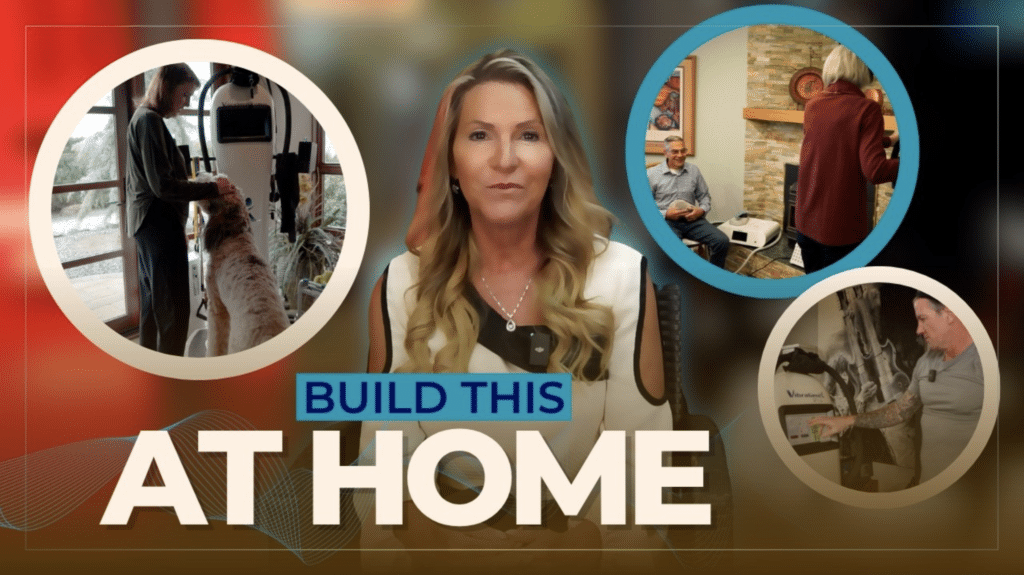
Imagine having a space in your home dedicated entirely to recovery, movement, relaxation, and longevity—without needing to drive to a wellness center every time you want to use advanced wellness technology.
For a growing number of people, that idea is becoming a reality.
A home recovery room, sometimes called a home wellness room, biohacking room, or personal longevity space, brings multiple wellness modalities together in one convenient place.
And according to VibraGenix founder Dr. Caroline Stites, creating one may be simpler than you think.
“Have you ever thought about building a home recovery and longevity center in your house? It is simpler than you think.”
The goal isn’t to fill a room with every wellness gadget available. It’s to select technologies you’ll actually use consistently and create an environment where taking care of yourself becomes part of everyday life.
What Is a Home Recovery Room?
A home recovery room is a dedicated space containing wellness and recovery technologies that can be incorporated into your regular routine.
It can be an entire room, a converted home gym, part of a bedroom, an office, a basement, or even a designated corner of your home.
The idea is simple: instead of making wellness something you have to schedule somewhere else, you bring the experience home.
Your personal longevity space might incorporate:
- Whole-body vibration
- Sound frequency technology
- Red and near-infrared light
- Green light
- PEMF
- Massage and relaxation technology
You don’t necessarily need everything at once. Start with the modalities that align with your lifestyle and build from there.
1. Start With Whole-Body Vibration + Sound Frequency
One of Dr. Caroline’s foundational choices for a home recovery space is VibraGenix technology.
VibraGenix systems are designed to bring whole-body vibration, movement and sound frequency technology together into an easy-to-use wellness experience.
VibraGenix incorporates a library of 3,000+ sound frequency formulas, giving users a wide range of options for creating personalized wellness routines.
For people building a home wellness space, this type of technology can become a centerpiece because it provides multiple ways to incorporate movement, vibration and frequency into a daily routine.
Why include vibration and frequency technology?
Whole-body vibration provides mechanical stimulation while you’re standing or exercising on the platform, making it an interesting addition for people focused on movement, balance, fitness and active aging.
Sound frequency adds an entirely different sensory component, allowing your wellness room to incorporate immersive sound and vibration experiences as well.
The biggest advantage?
It’s already in your home.
Ten or twenty minutes can become part of your morning, post-workout, evening, or recovery routine without another appointment or drive across town.
2. Add Red Light Therapy
Red light therapy has become one of the most recognizable technologies in modern home wellness spaces.
Also known as photobiomodulation, red and near-infrared light devices use specific wavelengths of light that interact with biological tissue.
Research into photobiomodulation has explored its relationship with cellular processes, exercise recovery, skin health and other applications.
For a home recovery room, you might choose a smaller red light panel or invest in a larger full-body system depending on your available space and goals.
VibraGenix’s Ilumia Elite, for example, combines a full-body red and near-infrared light experience with VibraGenix sound frequency technology.
That allows one piece of equipment to incorporate multiple modalities into the same wellness environment.
3. Don’t Forget Green Light
Red light may receive most of the attention, but green light offers a very different wellness experience.
VibraGenix Green Light technology is designed to create a calming environment that complements traditional red light routines.
It’s an option for people interested in relaxation, nervous-system wellness and skin appearance, and it can be particularly useful when designing a space that isn’t solely focused on physical performance.
Think of your longevity room as somewhere you can both activate and unwind.
Red and green light can provide different experiences depending on what you want from your routine that day.
4. Consider a PEMF Mat
Another technology Dr. Caroline recommends considering is PEMF, or pulsed electromagnetic field technology.
PEMF devices generate pulsed electromagnetic fields and have become increasingly common in wellness, fitness, recovery and biohacking environments.
A mat is particularly convenient for home use because you can simply lie down and incorporate it into a relaxation or recovery routine.
Some people also combine—or stack—PEMF with other modalities rather than using each technology completely separately.
5. Create Space for Relaxation
Not everything in your home recovery room needs to feel high-tech.
Dr. Caroline also recommends something very familiar:
A great massage chair.
Why?
Because sometimes your body simply needs an opportunity to relax.
A massage chair, comfortable seating, soft lighting, music and a calming environment can transform a collection of wellness equipment into a space you actually want to spend time in.
That’s important.
The best home recovery room isn’t necessarily the one with the most expensive equipment.
It’s the one you’ll consistently use.
The Real Benefit: Making Wellness Convenient
There’s a reason home gyms became so popular.
Convenience changes behavior.
The same concept applies to recovery and longevity.
When your wellness technology is down the hall instead of across town, it’s easier to build it into your routine.
Wake up and use your VibraGenix.
Use red light after a workout.
Relax on your PEMF mat in the evening.
Spend time under green light while unwinding.
Use the massage chair before bed.
Instead of wellness being something you occasionally go do, it becomes part of how you live.
Build Your Own Personal Longevity Space
Dr. Caroline’s reason for creating a home longevity space goes beyond convenience.
It’s about thinking further ahead.
Many of us spend decades working toward the life we hope to enjoy later—the house, travel, hobbies, retirement and time with the people we love.
But longevity isn’t simply about reaching those years.
It’s about supporting the movement, energy, independence and vitality that allow you to enjoy them.
That’s the philosophy behind VibraGenix:
More Good Years. Not Just More Years.
A home recovery room is one way to make wellness a consistent part of the life you’re building today.
How Much Space Do You Need for a Home Recovery Room?
Not as much as you might think.
You could create a simple setup with a VibraGenix system, light therapy panel and PEMF mat in a spare bedroom or home gym.
With more room, you could create a full personal wellness center incorporating:
VibraGenix + Red Light + Green Light + PEMF + Massage + Relaxation
The goal isn’t to recreate a medical clinic.
It’s to build a comfortable space around your lifestyle and the wellness technologies you’ll actually use.
Home Recovery Room FAQs
What should be in a home recovery room?
A home recovery room can include whole-body vibration, sound frequency technology, red and near-infrared light, green light, PEMF and massage or relaxation equipment. The right combination depends on your goals, budget and available space.
Can I build a recovery room in a small space?
Yes. You don’t need an entire home gym. A spare bedroom or dedicated section of an existing room can work. Start with one or two core technologies and expand your setup over time.
What is the difference between a home gym and a home recovery room?
A home gym is primarily designed around exercise and physical training. A home recovery or longevity room typically incorporates technologies and experiences focused on wellness, relaxation, movement and recovery. Many people combine the two concepts.
What is modality stacking?
Modality stacking means incorporating multiple wellness technologies into a broader routine—for example, combining whole-body vibration, sound frequency, light therapy and PEMF rather than relying on only one modality.
Is a home longevity room only for athletes?
No. Home wellness spaces can appeal to athletes, active adults, longevity enthusiasts, busy professionals and people who simply want convenient access to wellness technology at home.
Ready to Build Your Home Recovery & Longevity Space?
You don’t have to build everything at once.
Start with the technology that makes the most sense for your lifestyle and create your space from there.
Explore VibraGenix whole-body vibration and sound frequency systems, Ilumia light technology, Green Light technology, PEMF and other home wellness solutions at VibraGenix.
Or connect with the VibraGenix team to discuss which technologies could work best for your space.
Your home already supports the life you’ve built. Maybe it’s time to create a space dedicated to helping you enjoy it.
More Good Years. Not Just More Years.
VibraGenix products are intended for general wellness purposes. Information in this article is educational and is not intended to diagnose, treat, cure, or prevent any disease. Individual experiences vary.